The Only Children's Book Studio That Gives You The Book, The Cover,
The Etsy Edition, A Read-Along Video
And A Prompt Pack To Sell — From One Lesson.
Type one word — kindness, honesty, courage — and walk away with five things to sell: a laid-out KDP interior at the exact trim, a full-wrap cover with its spine, a US Letter edition for Etsy, a narrated, page-turning video of any tale, and every prompt of the book in one file you are free to sell as a prompt pack. Every picture raised to 300 DPI, all of it made in the ChatGPT account you already pay for. One payment of $17.
- No design work
- No page layout
- No API keys
- No credits
If you can type a word and paste a prompt into ChatGPT, you can do this.

Dear Friend,
If you have ever tried to make an illustrated children's book with AI, you already know the moment I am talking about.
Page one looks wonderful. A little red fox in a green scarf, standing at the edge of a meadow. You think, this is going to be easy.
Page two, the fox is orange. Page three, the scarf is gone. Page four, the fox has become something closer to a dog. Page five has the words of your story printed across the fox's face, because the picture filled every inch of the page and left nowhere for the text to go.
And by page six you are doing what almost everyone does at this point.
You are closing the tab.
I want to tell you why that happens, why it is not your fault, and what I built to fix it. It is a slightly long letter. Children's books are a slightly long subject. But if you publish on Amazon KDP or sell printable books on Etsy - or you have wanted to - I think it will be worth your ten minutes.
The Problem Is Not The AI.
The Problem Is Everything Around It.
Here is the uncomfortable truth nobody selling "AI book" shortcuts tells you.
The image model inside ChatGPT is perfectly capable of drawing a lovely page. What it cannot do on its own is remember. Every picture you ask for is drawn fresh. It does not know that the hedgehog on page seven has to be the same hedgehog from page two. It does not know your book is 8.5 inches square. It does not know that KDP needs 300 DPI, or that a paperback needs a bleed, or that the bottom third of the picture has to stay quiet so a child can actually read the sentence printed over it.
So you end up doing all of that by hand. Writing the same long description of the same animal over and over. Guessing at sizes. Dragging pictures around in a design tool at midnight. Working out spine widths with a calculator. Then finding out at upload that the interior was 72 DPI and KDP will not print it.
That is not a creative problem. It is a production problem. And production problems are solved with a system, not with more effort.
The Three Mistakes That Sink Almost Every AI Picture Book
Before I show you the studio, let me save you some pain. Whether you ever buy anything from me or not, these three mistakes are worth knowing about.
Describing the character differently every time.
You write "a small fox" on page one, "a cute red fox" on page two and "the fox from before" on page three. To you those are the same animal. To an image model they are three different requests, and you get three different foxes.
The fix is boring and strict: one exact description, word for word, on every page - plus a reference picture of that character to draw from. Almost nobody keeps that discipline by hand for thirty or forty pages. That is why the books drift.
Asking for a picture instead of a page.
A picture wants to fill the frame. A page has to share the frame with words. If you do not tell the model where the words will go, it will happily put a tree, a face or a busy pattern exactly there - and your sentence becomes unreadable.
The fix is to ask, in every prompt, for a calm and simple area in a specific part of the picture, and then to set the text only where that calm area really ended up.
Thinking about printing last.
Screen pictures are small. Print needs 300 DPI at the real trim size, a bleed around the edge, fonts that are embedded, a page count KDP accepts and a spine that matches it. Discover that at the upload screen and you are starting again.
The fix is to build the book around print from the first page.
Why I Built FableForge
I make and sell digital products for publishers. I kept watching the same thing happen with children's books: a good idea, a good start, and then the whole thing collapsing under the production work.
So I sat down and wrote out every single decision a finished picture book actually needs. Reading age. Words per page. How many tales. Which animal, described the same way every time. Where the words sit on each page, and which part of the picture has to stay calm to hold them. Trim size, bleed, resolution. Front matter, a lesson page after each tale, "The End", a copyright page, a back cover, a spine that matches the page count.
Then I turned all of those decisions into software - so you only make the few choices that are genuinely yours, and the studio handles the rest.
That software is FableForge.
One-time $17 · No credits · No API keys · Your login is emailed to the address you use at checkout
FableForge
Read that again, because the "your own ChatGPT" part matters.
FableForge does not charge you credits. It does not ask for an API key. It does not run up a bill every time you press a button. The words and the pictures are made in the ChatGPT account you already have - which means the quality is the quality you already see there - and the studio does everything ChatGPT cannot do on its own.
Make one book or fifty. There is no counter ticking down.
Real covers from books finished in FableForge.
How It Works - Four Steps, In Plain English
Set it up
Pick the kind of story - a moral fable or a bedtime story - type the lesson, and choose a reading age: 3-5, 6-8 or 9-12. Choose a ready-made book shape and how much of the book is illustrated. The studio shows you how many pages and pictures that makes, and roughly how long the pictures will take.
Write the tales
Press "Copy the prompt". Paste it into ChatGPT. Paste the reply back. That prompt already carries the whole brief: the reading age, the words per page, one animal per illustration, a scene that matches its own text, and the exact format the studio needs back. Longer books are written in parts so no reply gets cut off.
Make the pictures
Every page gets its own card with its own prompt. Start with each tale's character sheet, then make each page with that sheet attached, so the fox stays the same fox. Download each picture and drop it on its card - or drop a whole batch at once.
Build and download
Each picture is measured, placed with the words in the calm area the prompt reserved, and raised to 300 DPI. Press Build, and you get your print files.
A Walk Through One Real Book
Let me make this concrete. Here is what the studio worked out for a short book I built while testing it: a Sampler, lesson "kindness", reading age 6 to 8, the 8.5 × 8.5 trim, fully illustrated.
One animal per tale, each tale with its own title, a closing moral line, and three pages of text with a matching scene for every page - exactly the structure the studio's writing prompt asks ChatGPT to return.
Front matter, the story pages, a lesson page after each tale and "The End", padded up to KDP's minimum.
The studio's estimate was about 45 minutes of picture-making, shown before a single picture was made.
As it was uploaded, then one press of Build to bind the interior, the wrap cover with its spine, the Etsy edition and the listing pack.
That is the whole job. The creative decisions - the lesson, the reading age, the look of the book, the pictures you keep - stay yours. The production is the studio's problem.
What You Walk Away With
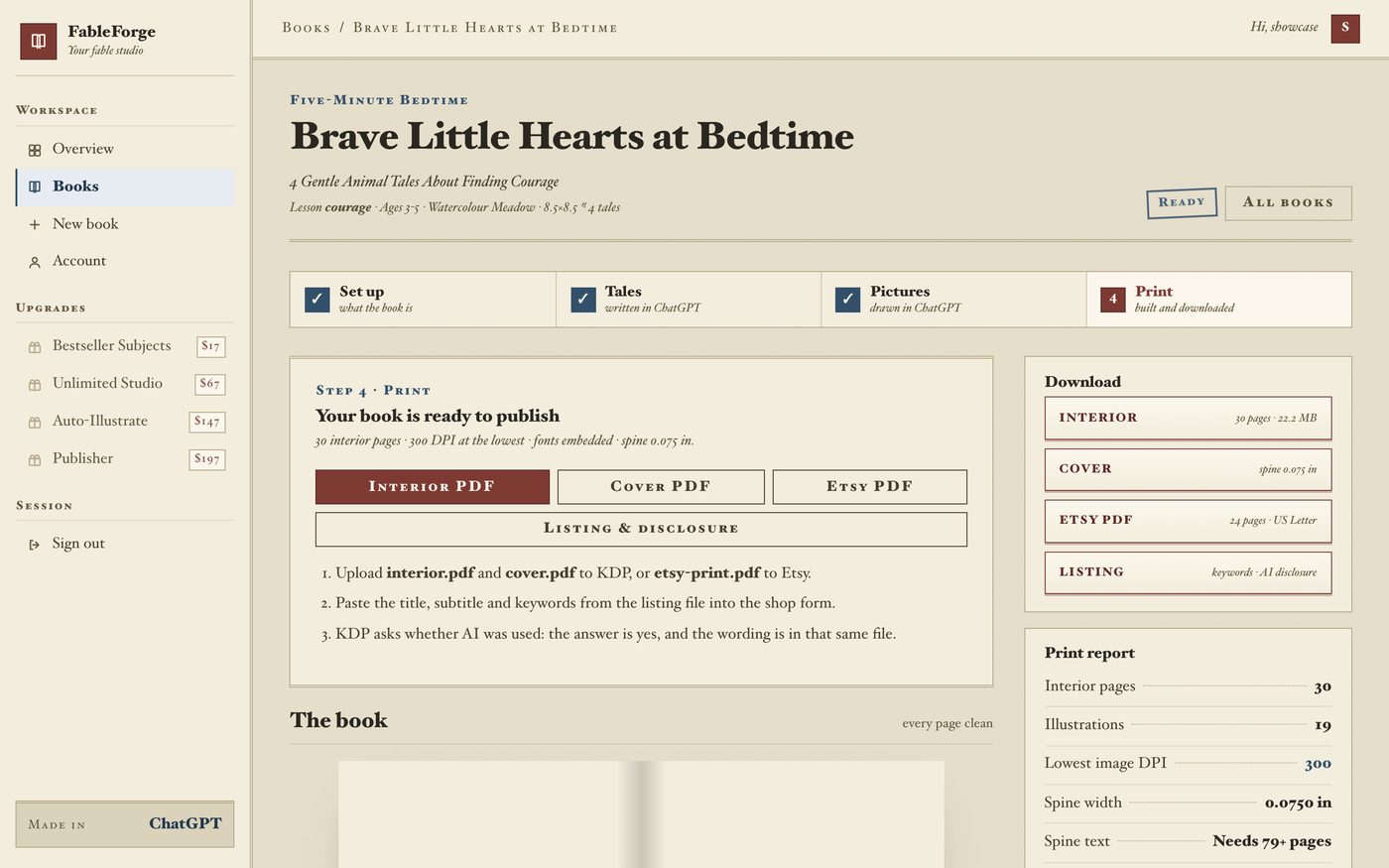
The finished book: four downloads and a print report - page count, lowest DPI, spine width, fonts embedded.
When a book is built, FableForge hands you four files:
interior.pdf
The full interior at your trim size, with bleed, embedded fonts, a contents page, a lesson page after each tale, "The End", and a copyright page. Padded to KDP's 24-page minimum and to an even page count.
cover.pdf
Back, spine and front as one wrap, with the spine width worked out from the final page count.
etsy-print.pdf
A US Letter edition with safe margins, for buyers who print at home.
The listing pack
Title, subtitle, keywords and categories to start your listing, the print specification, and the AI disclosure wording KDP asks for.
Every Tale Can Now Become A Read-Along Video
The same book, a second product. Pick a tale, pick a voice, and the studio turns it into a narrated video: the book opens, the pages turn, and the words light up at the bottom of the screen as they are read — the way children's story channels do it.
28 narrator voices, free.
Warm storytellers, a gentle teacher, a grandpa, a bedtime whisper. One click to hear each, then style it: Natural, Young, Cartoon or Bedtime. No credits, no voice subscription.
Pages that turn like a real book.
Your actual printed pages, words and all, in an open book that turns each leaf with a curl, a shadow and a soft paper sound. Karaoke captions underneath, so children read along.
One 1080p MP4 per tale.
Tick the tales you want and press Export. A three-minute tale renders in well under a minute on a recent computer, straight to a file you can upload.
Fix one line, not the whole tale.
Every sentence has its own play and redo button. Change the voice and only the lines that need it are read again.
Or use your own voice.
Prefer to record it yourself, or use ElevenLabs? Drop in one audio file per page — the studio gives you each page's script to copy — and it builds the video around your recording.
Made on your computer.
The voices and the video are made right in your browser. Nothing is uploaded and nothing is metered, so the tenth video costs what the first did: nothing.
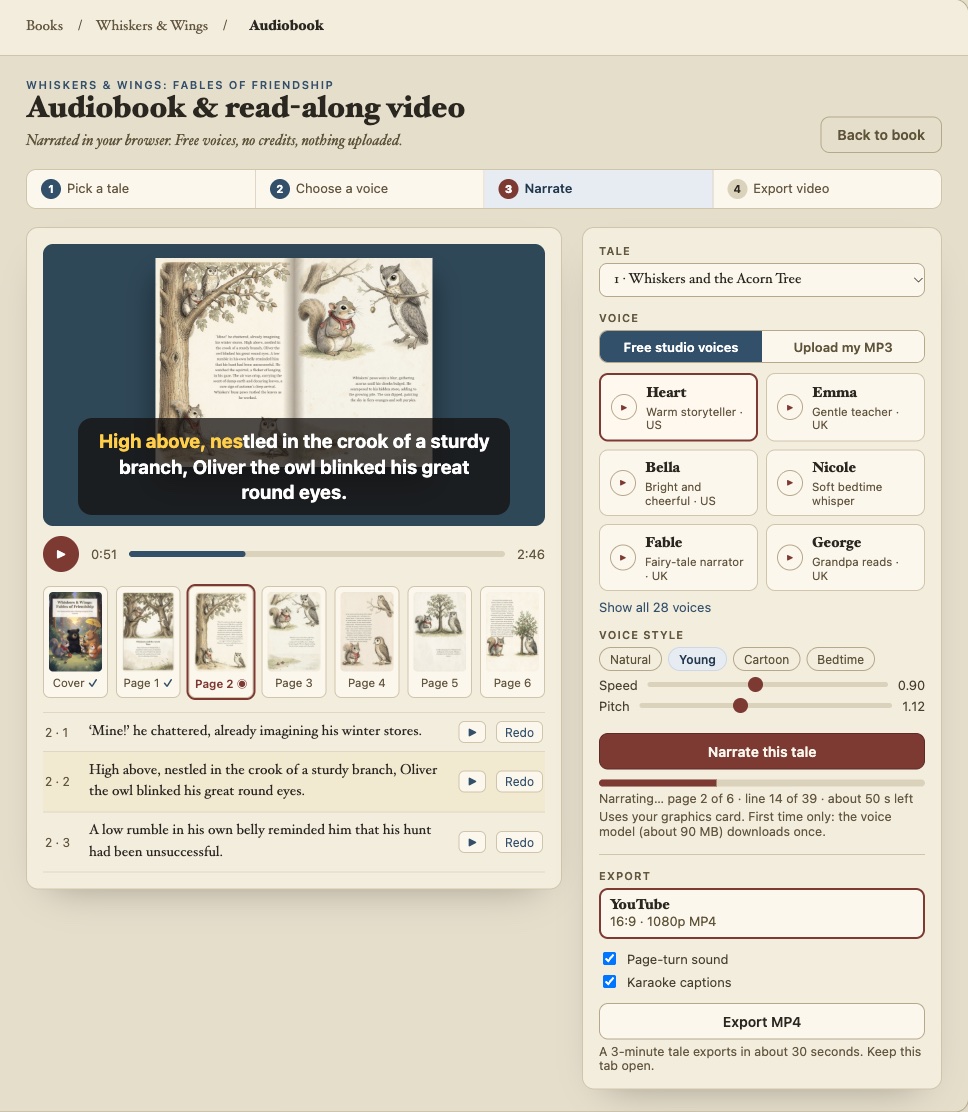
The Audiobook page: preview, page strip, every sentence, voices and export on one screen. Product mockup.
Where a read-along video earns its keep:
A story channel
Each tale is an episode. A twelve-tale book is twelve videos, each pointing back to the paperback.
A bonus that sells the book
Add the videos to an Etsy listing, or give them away to readers who buy the printed copy.
The classroom
A teacher can put a lesson's story on the board and let the class read along.

Your Books Live On Your Own Computer
Choose a folder once. Every book you finish is saved there as real files — the pictures, the print PDFs, the narration and the videos — and you can open any of them again later to change a page and rebuild.
Real files you can see.
One folder per book, readable in Finder or File Explorer. Nothing is locked inside an account you have to keep paying for.
Open it, edit it, rebuild it.
Bring a book back into the studio from your library whenever you want a new cover, a fixed page or another trim.
Backed up your way.
Put the library inside Dropbox, Google Drive or iCloud Drive and your books follow you to your other computers.
Here Is What's Inside, Point By Point
One-time $17 · No credits · No API keys · Your login is emailed to the address you use at checkout
What Makes A Fable Book Worth Buying
A parent flicking through a preview decides in seconds. Here is what they are looking for, and how the studio builds it in:
A lesson they can name.
One virtue per book, held across every tale, so the book answers the question the parent was searching for.
Characters a child recognises from page to page.
That is what the locked descriptions and character sheets are for.
Words a child can actually read.
Text length set by reading age, placed on a calm part of the picture, in a real book face.
A moment to talk about it.
A short lesson page after each tale gives the grown-up something to ask: "What would you have done?"
A book that feels finished.
Contents, a dedication, "The End", a back cover with a blurb. The small things that separate a book from a stack of pictures.
None of that is glamorous.
All of it is what makes a book look like it belongs on the shelf next to the ones people already buy.
The Old Way vs. The FableForge Way
Why Children's Fables?
Because they are one of the few kinds of book where the idea is the easy part.
Parents look for books about the exact lesson they are trying to teach this week: sharing, telling the truth, being brave at the doctor. Teachers look for stories to open a lesson on kindness or patience. Grandparents look for a gift. An animal fable with one clear lesson answers all three - and a collection of short fables makes a book that gets read again and again.
Parents
A book about the exact lesson they are teaching this week.
Teachers
A story to open a lesson on kindness or patience.
Grandparents
A gift that gets read again and again.
And this is not a hunch. Here is the shelf you would be publishing onto — four collections of short tales, as their own listings read this month. Click any one to read it full size.
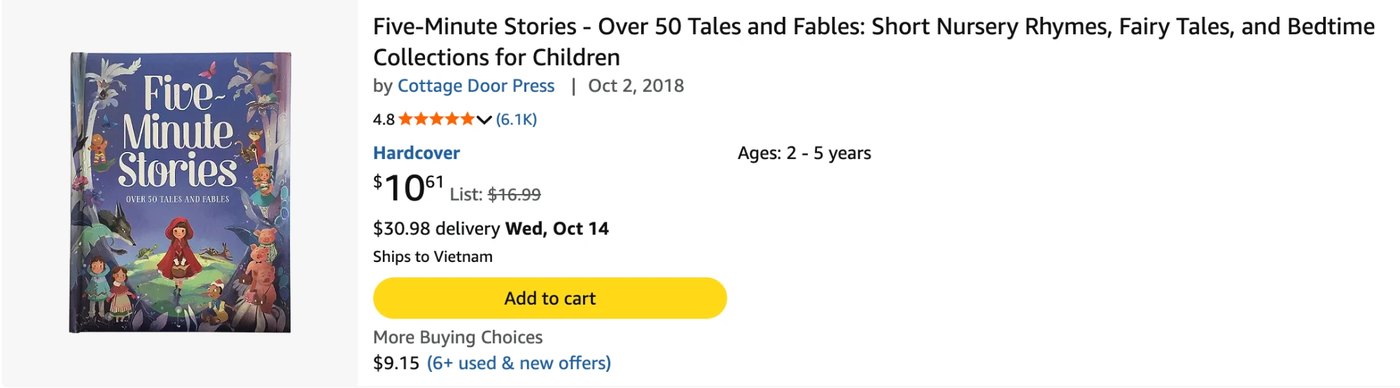
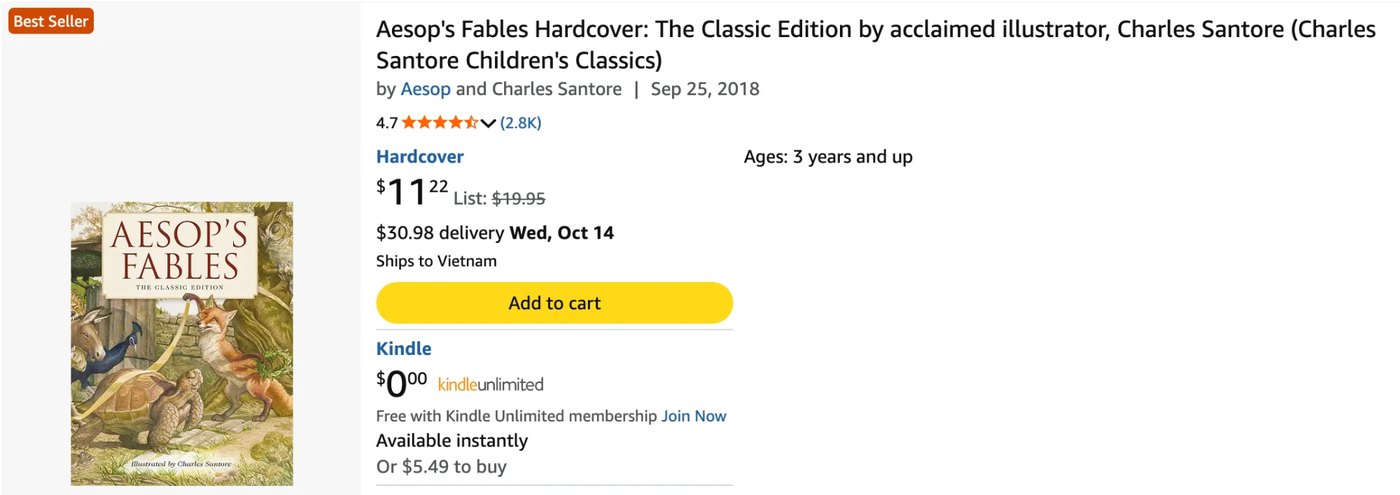
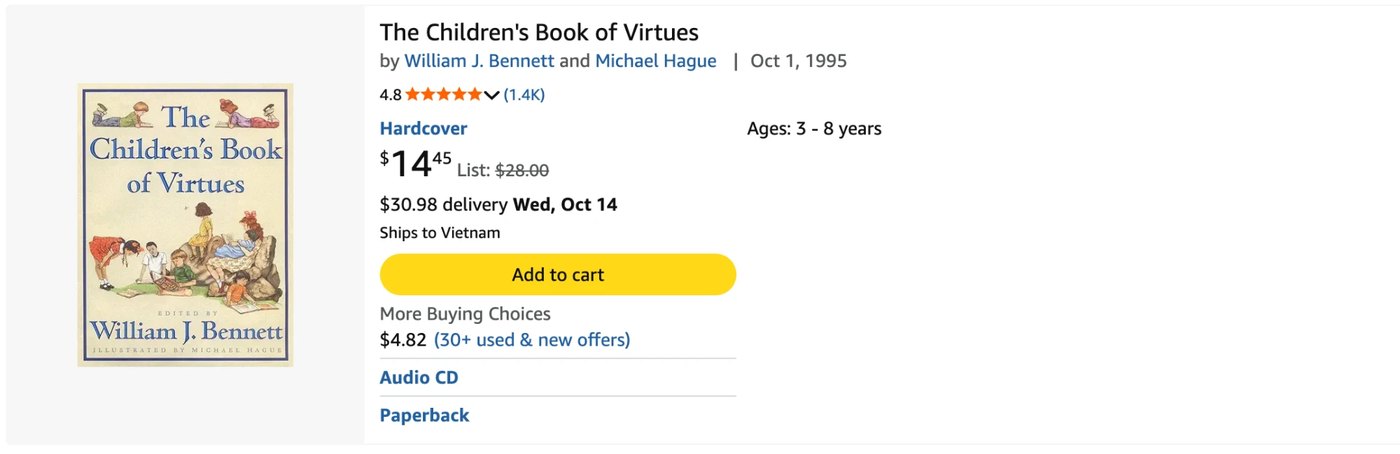
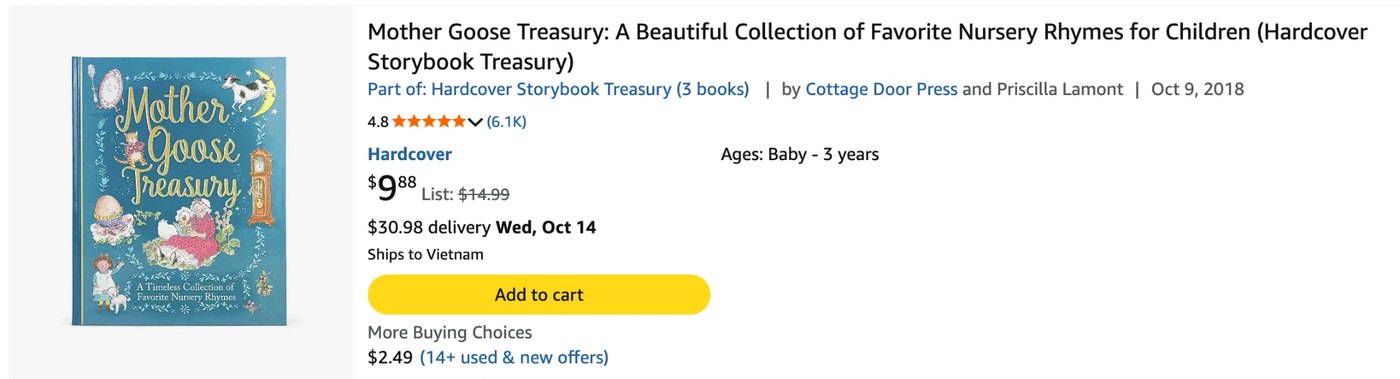
Not one of these is a new idea, and that is the point: a collection of short tales with pictures is a shape parents have been buying for thirty years. These are screenshots of other people's listings, taken in September 2026 — prices, ranks and rating counts move, Amazon pools a rating count across a title's editions and series, and the books and marks shown belong to their owners. Their sales are evidence that the shelf exists, not a promise about what yours will do.
Read What Their Customers Actually Praise
The ratings tell you the books sell. The reviews tell you something more useful: exactly which qualities a parent hands over money for — and every one of them is a decision you make in the studio, not a matter of talent.
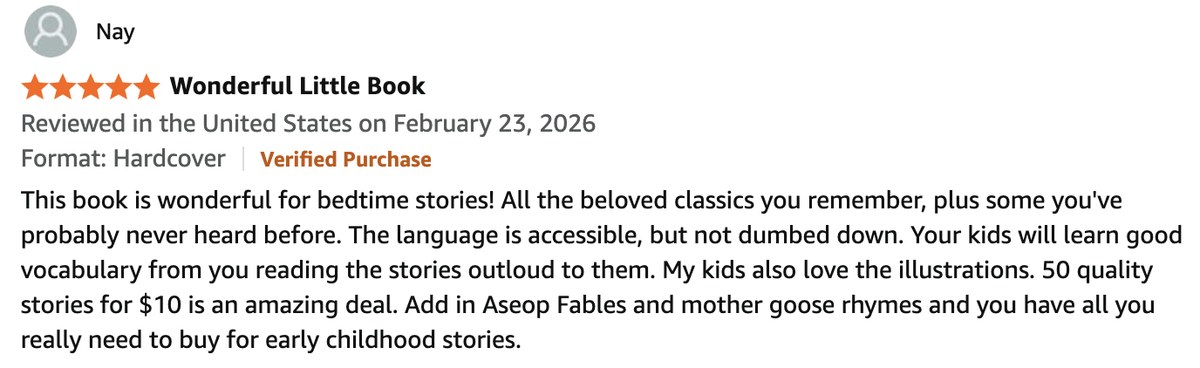
"50 quality stories for $10 is an amazing deal."
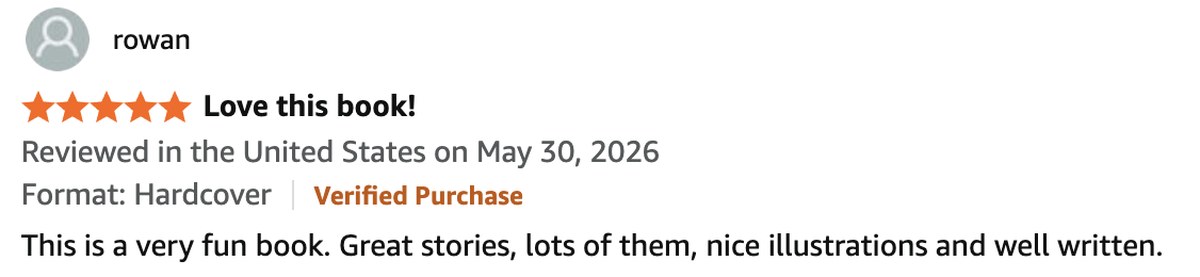
"Great stories, lots of them, nice illustrations and well written."
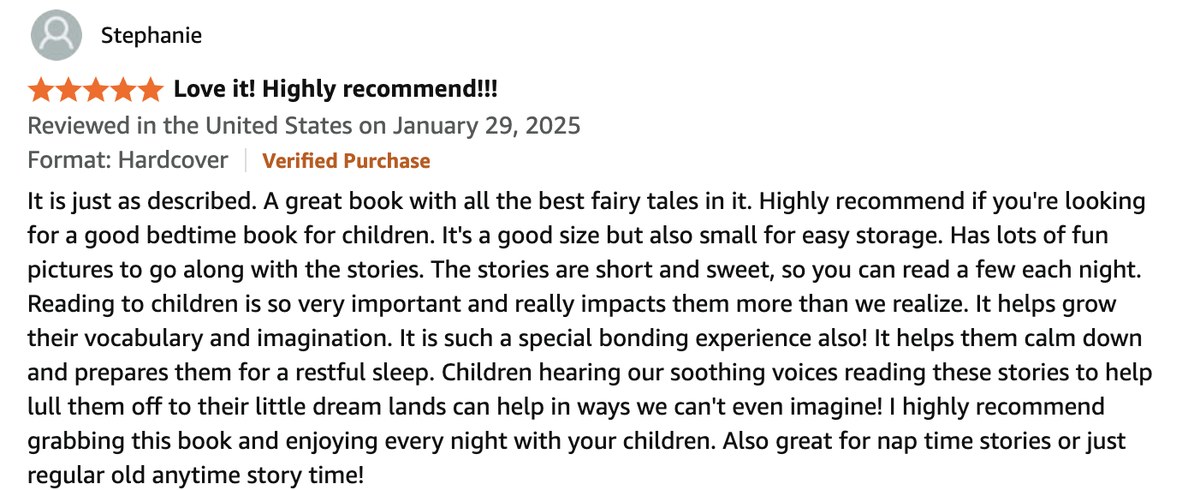
"The stories are short and sweet, so you can read a few each night."
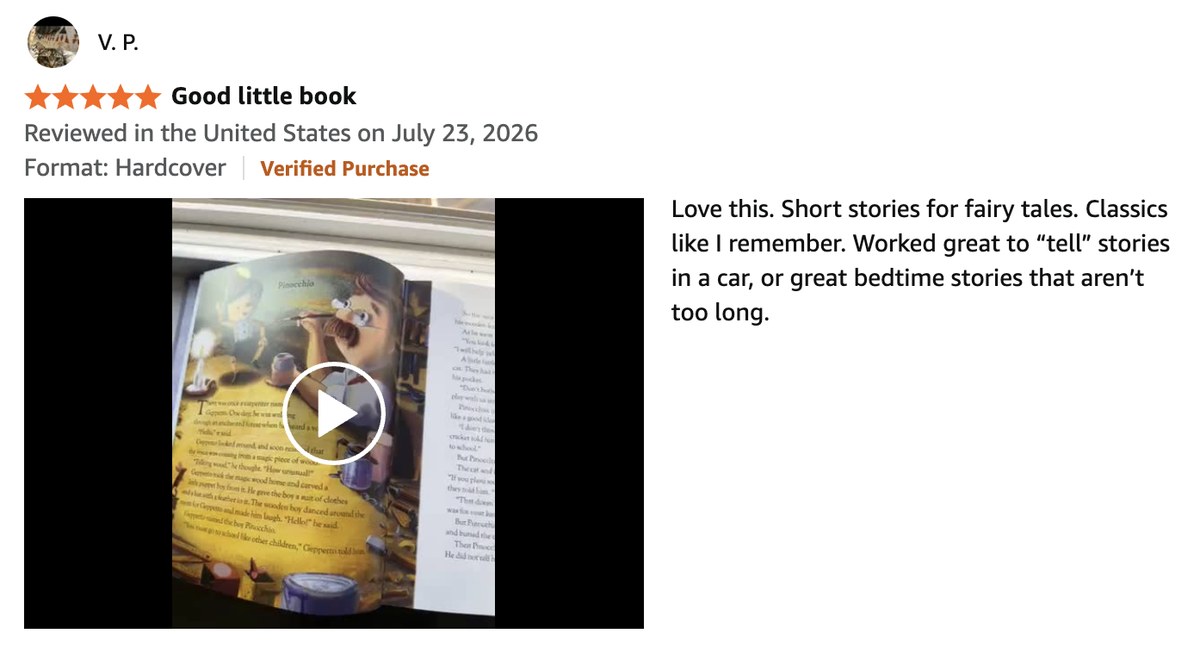
"Great bedtime stories that aren't too long."
To be completely clear: these are reviews of those books, not of FableForge. This studio is new and has no customer reviews yet, and I would rather show you real praise for the kind of book you are about to make than invent praise for the tool that makes it. Screenshots from the books' public Amazon listings, September 2026; the reviews and the books belong to their authors and publishers.
Let Me Be Straight With You About What This Is - And Isn't
I would rather lose a sale than sell you something you did not expect. So:
You need your own ChatGPT account.
The tales and the pictures are made there. FableForge does not include ChatGPT and does not log into it for you.
You still make the pictures.
The studio tells you exactly which prompt goes on which page and does everything around it - but you press the button in ChatGPT. The studio shows you an estimate of how long that takes before you start.
This front-end edition is deliberately focused
English books, the Vintage Storybook art direction, 8.5 × 8.5 and 6 × 9 trims, and up to 12 tales per book. Unlimited books within that. Bigger anthologies, more art styles, more trims and more languages are available as an upgrade inside the app - you never need them to finish a book.
It is not a get-rich button.
Nobody can promise you sales. What FableForge gives you is a finished, print-ready book instead of an unfinished folder of pictures. What you do with it is up to you.
Videos and the library need Chrome or Edge on a computer.
The voices, the video and saving to your folder all run in your browser, so they need a recent desktop Chrome or Edge. The first time you narrate, the voice model (about 90 MB) downloads once. Saved books leave our servers after seven days unopened - your folder keeps them, so keep it backed up.
Always follow the platform's rules.
KDP asks whether a book contains AI-generated content, and YouTube asks you to mark videos made for children and to disclose realistic synthetic content. Answer honestly.
FableForge Is For You If...
- You publish, or want to publish, children's books on Amazon KDP
- You sell printable books or activity packs on Etsy
- You have tried making picture books with AI and got stuck on consistency, layout or print quality
- You already use ChatGPT and would rather not pay for credits in yet another tool
- You are a teacher, parent or homeschooler who wants illustrated stories built around a lesson
- You want to make many books without being charged per book
It Is Not For You If...
- You do not have, and do not want, a ChatGPT account
- You want a book made with zero input from you
- You are looking for a tool for novels, non-fiction or adult books
- You expect a guarantee of income - there isn't one, from me or from anyone honest
What It Costs
Think about what a single illustrated children's book usually costs to produce the traditional way: an illustrator, a layout designer, someone who knows print specifications. Or think about the evenings you have already spent wrestling with it yourself.
FableForge is a one-time payment of
That is the launch price, and it is the price on this page today.
One-time $17 · No credits · No API keys · Your login is emailed to the address you use at checkout
What Happens The Moment You Click "Buy"
Our Purchase Policy
FableForge is web software that is switched on the moment you buy. Your login is emailed straight away, and the files you make with it are yours to keep. Because of that, all sales are final and there are no refunds.
That is exactly why this page tells you, in detail, what the studio does and does not do. If something is broken, a refund is not available - but a fix is. Email thuthao07082002@gmail.com and faults in the studio, downloads or account access are corrected at no charge. If you are unsure whether FableForge is right for you, email before you buy.
Questions People Ask
01Do I need to pay for anything else?
You need your own ChatGPT account to make the words and pictures. FableForge itself is a one-time $17 with no credits and no API key.
02Does FableForge log into ChatGPT for me?
No. You copy each prompt into your own ChatGPT and bring the result back. Automating a chat account breaks OpenAI's terms, so the studio never does it.
03How long does one book take?
It depends on the shape of the book and how many pictures it has. Before you start, the studio shows the page count, the number of pictures and an estimate of the time they take. A short Sampler is the quickest way to make your first book.
04Will the files pass KDP's print check?
The interior is built at your trim size with bleed and embedded fonts, every picture is raised to 300 DPI, the page count is padded to KDP's 24-page minimum, and the cover spine is sized from the final page count. Always review KDP's own preview before you publish.
05Can I sell the books I make?
Yes. The books you make are yours to publish and sell. The book font is licensed for that use. Follow Amazon's and Etsy's rules, including their AI disclosure questions.
06Can I sell the prompts as well?
Yes. Every book's prompts download as one text file, and they are yours: sell them as a prompt pack, bundle them with the book, or give them away. What you may not resell is the FableForge software itself.
07Is this a subscription?
No. The front end is a single payment. Some optional upgrades are offered after purchase; one of them has a monthly option, and it is clearly marked if you choose it.
08How do I get in after I buy?
Your login is emailed to the address you use at checkout, usually within a minute or two. Check spam if it has not arrived. You can always set a new password from the sign-in page.
09Are the narrator voices really free? Can I use the videos commercially?
Yes. The voices come from Kokoro, an open voice model under the Apache 2.0 licence, and run in your own browser, so there is nothing to pay per minute and the videos are yours to publish. Follow each platform's rules for children's and AI-made content.
10What do I need to make videos?
A recent Chrome or Edge on a computer. A computer with a graphics card narrates fastest; others work too, just more slowly. You can also upload your own recordings instead of using the free voices.
11Where are my books kept?
In a folder you choose on your own computer, as real files. The studio works on a book while you edit it and clears saved books it has not seen for seven days - your folder keeps them, and you can open any of them again.
12Which languages can I write in?
The front-end edition makes English books. More languages are available as an upgrade inside the app.
Here Is Your Decision
Option 1
You can close this page and go back to doing it the hard way - retyping character descriptions, fighting with layouts, and wondering why the file will not pass the print check.
Option 2
Or you can let FableForge carry the production, keep your own ChatGPT for the creative part, and finish the book you have been meaning to finish.
To your next book,
Thu Thao
Creator of FableForge
One-time $17 · No credits · No API keys · Your login is emailed to the address you use at checkout